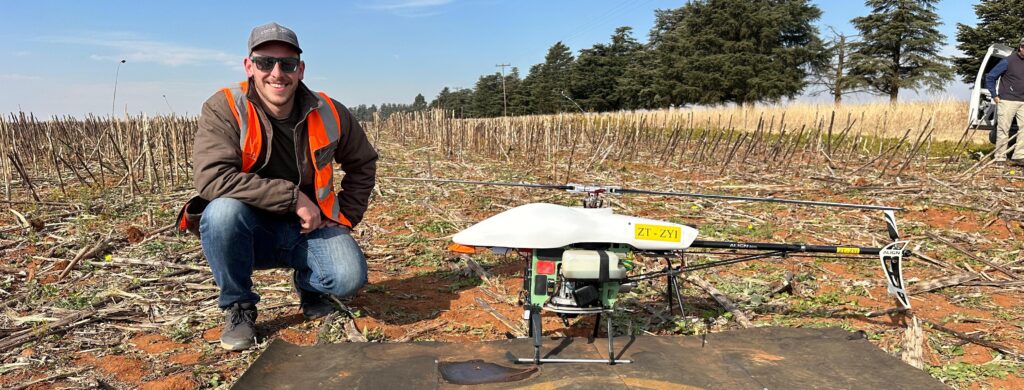
At A2D Geoscan, we’ve been pursuing a goal that many thought was out of reach: developing and flying a first-of-its-kind, petrol-powered helicopter drone in South Africa, with capabilities far beyond conventional UAVs. After years of hard work, regulatory navigation, and countless test flights, we recently reached a critical milestone: a successful BVLOS (Beyond Visual Line of Sight) demonstration for the South African Civil Aviation Authority (SACAA).
Introducing the Shrike: Built for the Future of South African UAV Aviation
The drone showcased during this demonstration is part of our Shrike series, a line of rugged, high-endurance helicopter drones purpose-built for real-world conditions. The specific model flown is simply known as Shrike.
What makes this moment historic is not just that we flew BVLOS — it’s how we did it. The Shrike, powered by a two-stroke internal combustion engine, sets itself apart in both endurance and environmental resilience. Unlike typical electric multi-rotors or fixed-wing systems, our platform is engineered to:
- Fly up to 2 hours continuously
- 3kg payload capacity
- Handle gale-force winds (Beaufort Scale Category 8)
- Operate in rugged environments
These features unlock new possibilities for:
- Long-range surveying
- Robust and scalable coms systems
- Infrastructure inspection
- Agricultural mapping
- Emergency response in hard-to-reach areas
The BVLOS Demonstration: Overcoming Challenges, Prioritizing Safety
Our demonstration day took place in cold, yet stable conditions. Spirits were high among the team and guests, many of whom captured the event on their phones, sharing in the energy of the moment.
Due to a low flying manned helicopter in general airspace, take-off was aborted several times before final take-off. After we took off, we noticed a minor communication issue regarding full telemetry feed to our ground control station (Mission Planner). Rather than push forward, we aborted and returned to home (RTL) to re-establish connection. We then ran a full pre-flight diagnostic to ensure everything was 100% ready before we continued the flight demo. This decision was praised by SACAA representatives as a model example of procedural discipline and commitment to safety.
These checklists, pre and post-flight, have become the backbone of our operations. They not only ensure safety but also demonstrate the professional standards needed for full regulatory approval.
We would like to commend the professional manner in which the CAA representatives handled the review.
The Flight: Terrain-Following Over 8KM
The test flight covered an 8km autonomous route, using:
- HereLink for HD video transmission
- 868 MHz antenna system for telemetry
- Mission Planner as the ground control station
- A pre-planned mission profile with terrain-following for safety and accuracy
The dual redundant telemetry signal remained consistently above 70%, a strong indicator of system robustness. While we experienced brief drops in the video feed, likely due to terrain interference over a valley, all telemetry and flight data were fully intact throughout.
SACAA Response: Recognition and Encouragement
One of the attending SACAA officials, himself experienced in building hobby aerial platforms, expressed his excitement. Not only was this the first petrol-powered helicopter drone he had seen registered in South Africa, but he also praised the design choices, from airframe structure to flight systems integration.
His Unofficial Statement:
“First operational certification of petrol heli UAS in SA” — SACAA Representative
His feedback reaffirmed that we are on the right path, balancing innovation with operational discipline.
What’s Next: Shrike Series Expansion & Operational Rollout
This demonstration marks a turning point not just for A2D Geoscan, but for South African UAV aviation as a whole. With the BVLOS test flight successfully completed, we move forward into the final stages of full regulatory approval and toward real-world deployment.
With the commitment and positive attitude of both the regulatory body and the commercial sector in general, A2D sees great value in developing a strong relationship to overall boost the value of UAS in South Africa through partners or otherwise.
As we prepare for operational use, we’re also actively developing new models within the Shrike series, with higher payload capacities and robust integration of advanced payload systems. The goal is clear: to provide flexible, dependable, and rugged aerial solutions for industries that require more than off-the-shelf UAVs can offer.
Acknowledgments
We would like to thank the following partners and hardware suppliers who helped us succeed in our journey.
Local: Lightware Systems, Flying Robot, Poynting Antennas, LookupPro
International: Rajant